


Published on Wednesday, 09 September 2026 11:09 |  |

| 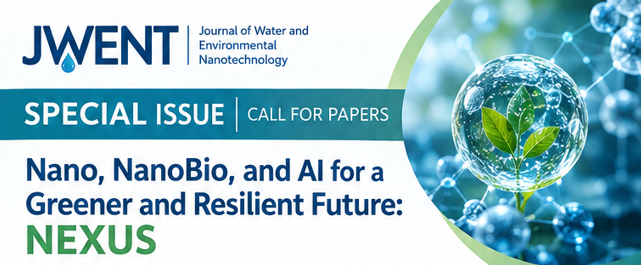
The Journal of Water and Environmental Nanotechnology (JWENT) is pleased to announce its official partnership and sponsorship of the upcoming ISET 2026 and RCEnvE 2026 conferences. In conjunction with this collaboration, JWENT has launched a Special Issue titled "Nano, NanoBio, and AI for a Greener and Resilient Future: NEXUS", offering priority editorial evaluation and publication consideration for selected papers presented at these events.
Published on Wednesday, 17 May 2017 09:56 | |
|
 12th International Conference and 5th Asian Congress on Environmental Mutagens (ICEM-ACEM 2017) with the 33rd Annual Meeting of KSOT/KEMS hosted by the Korean Environmental Mutagen Society (KEMS) will be held from November 12-16, 2017, in Incheon, Korea.
ICEM-ACEM 2017 promises to be a ground-breaking event, offering a most special chance to learn up-to-date knowledge and exchange ideas and information on the latest trends with colleagues. The conference website is (www.icem2017.org).
Published on Tuesday, 01 December 2015 14:14 | |
|

Journal of Water and Environmental Nanotechnology (JWENT) is an open-access, peer-reviewed international journal focused on the publication of cutting-edge scientific research at the intersection of nanotechnology, water science, and environmental sustainability. Published quarterly, the journal provides a rigorous platform for high-quality scientific work on the challenges related to water and wastewater treatment, environmental remediation, and ecological safety. JWENT welcomes original research articles, reviews, short communications, technical notes, case studies, and perspectives covering, but not limited to, the following areas:
Nanotechnology in Water & Wastewater Treatment (Advanced nanomaterials, AI-driven, and nano-enabled approaches for water and wastewater purification, desalination, disinfection, contaminant removal, water reuse, and resource recovery); Environmental Bioremediation (Nano-enabled physical, chemical, biological, and integrated solutions to clean up water, soil, sediments, and agricultural and industrial environments); Sustainable Environmental Nanotechnology (Synthesis and application of green, biological, low-energy, waste- and biomass-derived nanomaterials. Research using nanotechnology-based approaches that support sustainable development and the circular economy, such as nano-enabled agricultural inputs, pollution control, environmental remediation, and protection and enhancement of natural resources, is welcome); Smart Technology and Digital Innovation (Using AI, machine learning, computational modelling, big-data analysis, digital twins, nano(bio)sensors, and the Internet of Things (IoT) to optimize water and environmental processes; to predict nanomaterials’ performance and potential risks; and to enable real-time monitoring and decision-making), and Process Engineering, Resource Recovery, and Sustainability Assessment (Process design and scale-up, pilot plant trials, treatment of real environmental samples, material for recycling and reuse, energy and resource recovery, environmental catalysis, carbon management, and low-carbon water and associated technologies).
Our mission is to bridge the gap between lab discoveries and real large-scale environmental practices. JWENT serves a global audience of scholars, researchers, environmental engineers, and industry practitioners involved in sustainable water and environmental strategies through technological innovation. JWENT publishes all content under the Creative Commons Attribution 4.0 International License (CC-BY 4.0), ensuring immediate and free access.


